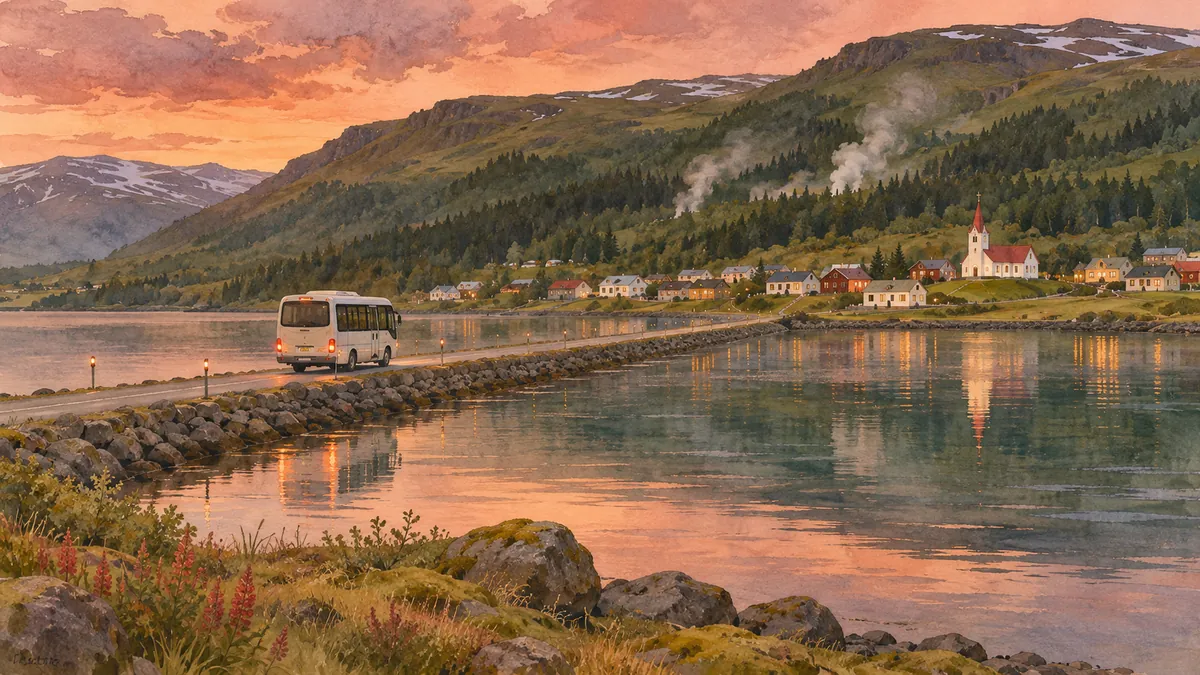
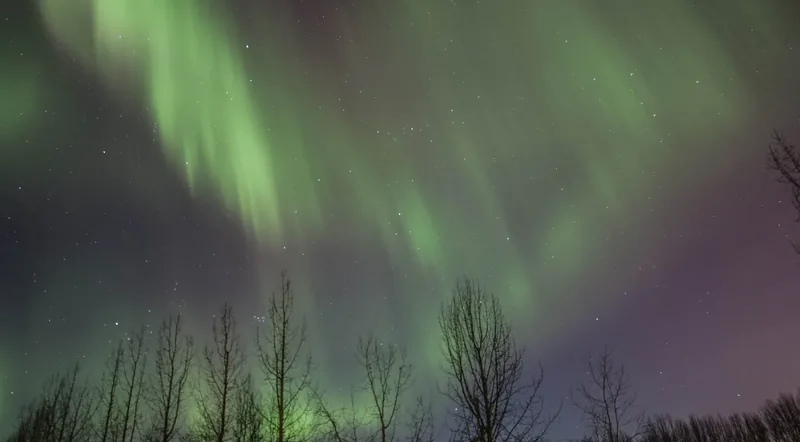
The Forest Lagoon (Skógarböðin) keeps the same hours all year: every day from 10:00 to midnight, out of the water by 23:30. What changes is the light, the crowds and the transport. For long, bright days and the clearest weather, go in June, Akureyri’s sunniest and driest month. For snow on the trees and dark evenings with a chance of the northern lights, go between October and March. September gives you both: the aurora returns while the summer crowds thin out. At any time of year, an evening slot is usually calmer than a mid-afternoon one on a cruise day.
Forest Lagoon entry with towel and drink
Which Month Suits Your Visit
- Green woodland and long days: June, the sunniest month, or July and August for the mildest air.
- Snow and a winter atmosphere: January to March.
- A possible aurora: September to early April, on a dark, clear night.
- Fewer visitors in the region: November to February, outside the holidays.
- Whale watching and a soak on the same day: June to August, with the longest days.
The Forest Lagoon Month by Month
Temperatures are average daily highs and lows for Akureyri, the 1991-2020 normals from the Icelandic Met Office station in town; the pools themselves stay at about 37-41°C all year. The busy bar uses Statistics Iceland guest nights for the whole of North-East Iceland: a measure of how full the region is, not a count of lagoon visitors.
Average highs and lows in Akureyri, sunset on the 21st, the lagoon's hours, and how busy the region is each month.
Jan
2.7° / -3.5°C
Busy
About 5 hours of daylight on the 21st and aurora season. Evening shuttle 18:45, back 22:00, except on 1 January, when the lagoon's hours are not published.
Feb
2.6° / -3.6°C
Busy
Daylight passes 9 hours by the 21st. Evening shuttle only. Icelandic schools take a winter break in late February.
Mar
3.5° / -2.6°C
Busy
Aurora around the equinox, about 12 hours of daylight. Easter falls on 25-29 March 2027 and German Easter breaks start on 22 March, so book slots ahead.
Apr
6.6° / -0.3°C
Busy
Aurora season ends around mid-April. The first cruise ship of 2027 is due on 11 April, before the port shuttle starts.
May
10.3° / 3.2°C
Busy
Long light evenings and one of the drier months (about 6 days with 1 mm or more of rain). The port shuttle runs only on listed extra days.
Jun
13.7° / 6.6°C
Busy
Sunniest month. The sky never gets dark: the sun sets just before 01:00 and rises about 01:30. Summer shuttles from 1 June: town run 17:30, port shuttle hourly.
Jul
15.1° / 8.5°C
Busy
Warmest and busiest month, with the cruise peak and many Icelanders on holiday. Book a time slot ahead.
Aug
14.8° / 7.9°C
Busy
Still busy. The 09:00 port shuttle runs to the end of August; Commerce Day long weekend is 31 July to 2 August 2027. Dark skies return late in the month.
Sep
11.8° / 5.4°C
Busy
Summer shuttles end on 6 September; from the 7th the town shuttle makes one evening run. Aurora season starts again.
Oct
6.6° / 1.1°C
Busy
Aurora season, but one of the wettest months, with about 12 days of 1 mm or more of rain. Evening shuttle only; German autumn breaks.
Nov
3.6° / -2.1°C
Busy
About 5 hours of daylight on the 21st and aurora season. Evening shuttle only, so a daytime visit needs a taxi or a car.
Dec
2.6° / -3.6°C
Busy
About 3 hours of daylight and the cloudiest month. No shuttle on 24, 25 and 31 December, and the lagoon's holiday hours are not published: check before you go.
Overnight stays in all registered accommodation in North East Iceland (Norðurland eystra) in 2025, as a share of July, from Statistics Iceland. They show when the region is busy, not a headcount at the lagoon.
Sources: Temperatures: WMO 1991–2020 climate normals for Akureyri (Icelandic Met Office station 422). Overnight stays: Statistics Iceland, table SAM01601, all registered accommodation, Norðurland eystra, 2025. Sunset: timeanddate.com for Akureyri, 21st of each month. Hours and shuttle: forestlagoon.is, read 21 November 2026. Holidays: timeanddate.com, Iceland 2027.
The lagoon publishes one timetable for the whole year. Its water comes from a road tunnel and its forest was planted from 1936; what changes is the light during its long hours, from near-daylight at 23:30 in June to darkness by mid-afternoon in December.
Winter or Summer at the Forest Lagoon
In winter, from October to March, you sit in hot water in cold air, often with snow on the birch and spruce and the lights of Akureyri across the fjord. Average highs are 2.6°C in December and February and 2.7°C in January. The trade-offs are short days, cloud and transport: from 7 September to 31 May the free town shuttle makes one evening run, at 18:45 from Skipagata, back from the lagoon at 22:00. A daytime visit in winter needs a taxi or a car, and the walkways can be icy.
Summer, from June to August, brings green woodland, the mildest air (an average high of 15.1°C in July), light at any hour and more shuttles: a port bus from Tangabryggja through the day and a town run at 17:30. It is also the busiest time: July alone accounts for 26% of the year’s guest nights in the region (274,550 of about 1.04 million in 2025), and Icelanders hold 41% of July’s nights, so local families fill the pools too. Book an entry slot ahead in July and August.
September balances the two: highs still average 11.8°C, the aurora returns, and guest nights fall to about a third of July’s.
What Each Part of the Year Brings
January and February
The coldest months, with about 5 h 22 min of daylight on 21 January and 9 hours a month later. The evening shuttle runs, except on New Year’s Day, when the lagoon’s hours are not published either. Reykjavík’s schools take their winter break in late February (Akureyri’s dates are not published).
March and April
Longer days, still wintry: 12 h 20 min of daylight on 21 March and 16 hours by 21 April, with dark enough nights for the aurora around the spring equinox. Easter falls on 28 March in 2027 (holidays from Maundy Thursday, 25 March, to Easter Monday, 29 March), German Easter breaks start on 22 March, and the First Day of Summer is 22 April: expect busier pools on those days.
May and June
The sky never gets dark from late May to late July, but Akureyri has no true midnight sun: on 21 June the sun sets just before 01:00 and rises again at about 01:30. For a sun that does not set, you have to go to Grimsey (the Arctic Circle). The high-season shuttle starts on 1 June, and June has the most sunshine, 189.9 hours in an average month.
July and August
The mildest and busiest months, with the cruise season at its peak and Icelandic and German summer holidays running. The Commerce Day long weekend runs from 31 July to 2 August in 2027. Book your lagoon slot first.
September and October
Autumn colour on the slope and darker evenings. The low-season timetable starts on 7 September, with the single evening shuttle. October is colder and wetter, with 74 mm of rain or snow in an average month, and German autumn school breaks fall in October and early November.
November and December
The darkest months, good for a lit evening soak. By 21 December you get about 3 hours of daylight (sunrise 11:39, sunset 14:42), and December records 0.3 hours of sunshine on average because the sun hardly clears the mountains. There is no shuttle on 24, 25 and 31 December or 1 January, and the lagoon does not publish its hours for those days: check forestlagoon.is before a Christmas or New Year visit. The Christmas House, south of town, keeps shorter hours out of summer (Visit Akureyri lists 10–18 from June to August, 12–18 from September to December and 14–18 from January to May; check before you go).
Daytime or Evening at the Forest Lagoon
In December the 10:00 opening comes before sunrise, so a morning or afternoon soak happens in twilight or darkness. In June the last half hour in the water, up to 23:30, is under a bright sky. Reviewers describe the evening most warmly, with the pools lit against the trees; the last reservation is 22:30.
Families should go earlier in the day: children of 12 and under should be out by 20:00, and the last entry on children’s tickets is 18:30.
Cruise Days, Holidays and Busy Weeks
Akureyri’s cruise season runs from about April to September or October, peaking in July. The first 2027 call is listed for 11 April, before the port shuttle starts, so April and most May passengers need a taxi or a tour. On days with several ships in port the lagoon fills and the changing rooms are busiest in mid-afternoon, so book a timed slot for the morning or evening.
Winter is not quiet at every hour: December 2025 had 28% more guest nights in the region than December 2024, and weekends and holidays bring local visitors. German summer holidays run from 28 June into mid-September, when Bavaria and Baden-Württemberg finish.
Northern Lights at the Forest Lagoon
The aurora season in Akureyri runs from about September to early April; the dark returns in late August and is gone by mid-April (our estimate). The main limit is cloud: October to January bring 11 to 12 days a month with rain or snow, and the town is cloudier than Reykjavik in the dark months, by one secondary analysis of Met Office data.
The lagoon is open in the dark until midnight, away from the town lights, so seeing the aurora from the water is possible; we found no first-hand report of it, and the lagoon makes no such claim. Watch the sky and expect nothing. Before you book an evening, open the Icelandic Met Office aurora page and look at the cloud map first: white is clear sky, green is cloud. Its 0 to 9 activity number matters less than the cloud. If the lights are the point of your trip, a northern lights tour from Akureyri drives to where the sky is clear.
Winter Weather and the Road to the Lagoon
The pools are warm when the air is well below freezing, but the paths can be slippery and the wind off the fjord bites. If you drive, check road conditions on umferdin.is or call 1777 first, even for the short trip from town, and skip the bar. The getting-there guide has the full shuttle timetable.
Live conditions and sources
The strip at the top of our homepage shows Akureyri now and tonight’s forecast. Its sources:
- Temperature, wind and gusts in Akureyri: the Icelandic Meteorological Office (vedur.is) automatic station 3471, Akureyri-Krossanesbraut, read live in your browser. Licence: CC BY 4.0.
- Weather warnings for Northeast Iceland: the Icelandic Meteorological Office’s active warnings, also CC BY 4.0.
- Daylight today and sunrise to sunset: calculated in the page with NOAA’s solar equations for Akureyri.
- Kp index tonight: NOAA Space Weather Prediction Center (Source: NOAA SWPC), public domain.
- Cloud cover tonight: MET Norway’s locationforecast 2.0 (Data from MET Norway, CC BY 4.0). MET Norway’s terms do not allow browser calls, so this figure is a snapshot taken when the site is rebuilt and can be a few hours old.
- The Forest Lagoon cell: the hours (10:00 to midnight) and the shuttle season from forestlagoon.is, checked on 21 November 2026, worked out from today’s date. On 24, 25 and 31 December and 1 January it reads “Check hours” and “No shuttle today”.
The strip reports the weather and the lagoon’s published hours. It never says whether a tour runs: the operator decides on the day and contacts you if plans change.
The month-by-month figures on this page come from the WMO 1991-2020 climate normals for Akureyri (Icelandic Met Office station 422), Statistics Iceland table SAM01601 (guest nights in all registered accommodation in Norðurland eystra, 2025), daylight calculated for 2027 and checked against timeanddate.com, holidays from timeanddate.com and schulferien.org, and the Icelandic Met Office aurora forecast page.
Frequently Asked Questions
What is the best month to visit the Forest Lagoon?
June for long, bright days and the most sunshine; September for the aurora’s return with fewer visitors than summer; October to March for snow and dark evenings. July is the busiest month, so book a slot ahead then.
Can you visit the Forest Lagoon in winter?
Yes. It is open every day from 10:00 to midnight all year. Snow, ice, wind and road conditions affect the journey more than the soak, and from 7 September to 31 May the free shuttle makes one evening run, 18:45 from Skipagata and back at 22:00.
Can you see the northern lights from the Forest Lagoon?
It is possible on a dark, clear night between about September and early April, because the lagoon stays open until midnight away from the town lights. Nothing is promised and we found no first-hand report of it. Check the cloud map on the Icelandic Met Office aurora page before you go.
Is the Forest Lagoon open at Christmas and New Year?
The lagoon does not publish its hours for 24, 25 and 31 December or 1 January, and the free shuttle does not run on those days. Check forestlagoon.is before you plan a holiday visit.
Check Forest Lagoon Ticket Dates and Prices
Pick your date and entry time for the lagoon's own ticket with a towel and a drink. Evening slots run until 22:30; free cancellation up to 24 hours before.
Check Dates & Prices